
Blog
Why Fallowing Arizona Desert Soils Causes Salt Buildup (And How to Protect Them)
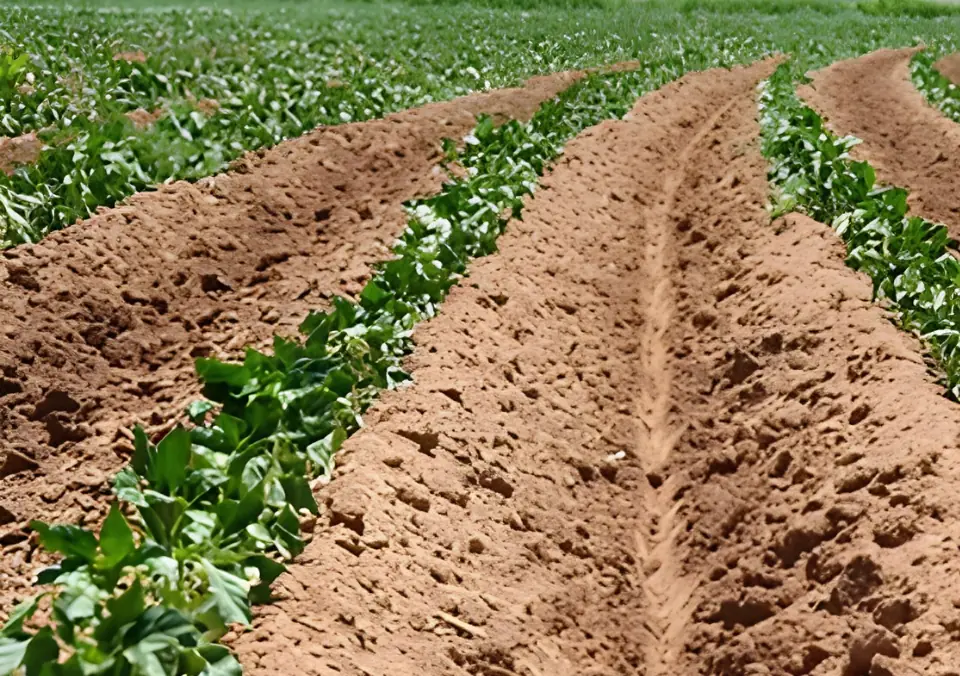
A recent online comment suggested that letting farmland “lay out fallow” is simply a healthy form of crop rotation. It’s an understandable idea—many of us picture resting land as a natural way to rebuild soil. In Arizona’s desert farming regions, however, the reality is quite different, according to University of Arizona agronomist Dr. Jeff Silvertooth.
“A classic crop rotation example is the sequencing of cotton, wheat, and alfalfa that has been common in central Arizona for many decades,” Silvertooth said. “In this case cotton is the warm-season, broadleaf crop (a perennial plant grown as an annual); wheat is the cool-season grass crop, and alfalfa is the perennial deep-rooted leguminous crop. A good crop rotation system provides a complementary series of crops, ideally including a perennial legume crop.”
In plain terms, true crop rotation means deliberately switching between different kinds of plants—varying the season they grow, the plant family, how deep their roots reach, and what they take from or give back to the soil. This complementary approach helps keep soil productive over time. One crop sets the stage for the next. The University of Arizona’s research on this and the agriculture college provides ongoing insights into soil health.
Fallowing is not the same thing. It means leaving a field completely bare, with no crop at all. In the desert Southwest, this practice is generally counterproductive, especially when the goal is simply to save irrigation water.

In dry climates, far more water evaporates from bare soil than falls as rain. This pulls salts upward and leaves them concentrated near the surface. “That is a particular problem in areas with drainage problems and higher water tables,” Silvertooth explained. Over time, those salts make it harder for future crops to grow.
Bare ground also harms the soil microbiome—the community of microscopic life (mostly bacteria and fungi, along with other tiny organisms) that supports plant roots and keeps soil functioning. These organisms are essential for healthy crops, but “the soil microbiome needs water to live and fully function.” Without regular water, that living community declines.
Farmers in irrigated desert systems sometimes fallow land when water supplies shrink. “In irrigated crop production systems farmers will fallow land to save water. That is common when irrigation water sources are reduced. In that case, desert farmers will typically fallow marginal land first and focus the water that is available on the fields they plant,” Silvertooth said.
“Field experimentation on common agronomic crops have consistently shown steady, consistent crop growth throughout the season and yield response to irrigation water. Farmers generally understand this relationship very well. They know that if they reduce irrigation to a crop due to reduced water availability, they will experience a loss in crop vigor and yield. So, they focus their available water on the fields they plant, and they must be careful not to over-plant their water supply.”
This is exactly what has happened in Pinal County. After two irrigation districts lost access to Colorado River water through the Central Arizona Project, roughly half of the county’s prime farmland now sits fallow. For many of these fields—especially those that are leased—the decision was forced by water cuts, not chosen for soil health. Similar situations exist in California’s Imperial and Palo Verde Valleys, where irrigation districts have transferred Colorado River water to urban users and therefore plant fewer acres.
When desert land is eventually brought back into production, growers typically need extra water to flush accumulated salts from the surface and to help the soil microbiome recover. Fallowing does not rest or regenerate desert soils the way many people assume. It creates extra challenges that must later be corrected.
“Thus, crop rotations are a good practice,” said Silvertooth. “Fallowing land is not part of desert crop rotations; it’s a negative consequence of losing access to irrigation water.”
How Fallowing in Desert Soils Creates Salt Buildup
Fallowing causes salt buildup in desert soils, primarily through upward water movement and evaporation, with little or no leaching to flush salts downward. Dr. Silvertooth gives the lay of the land on this.
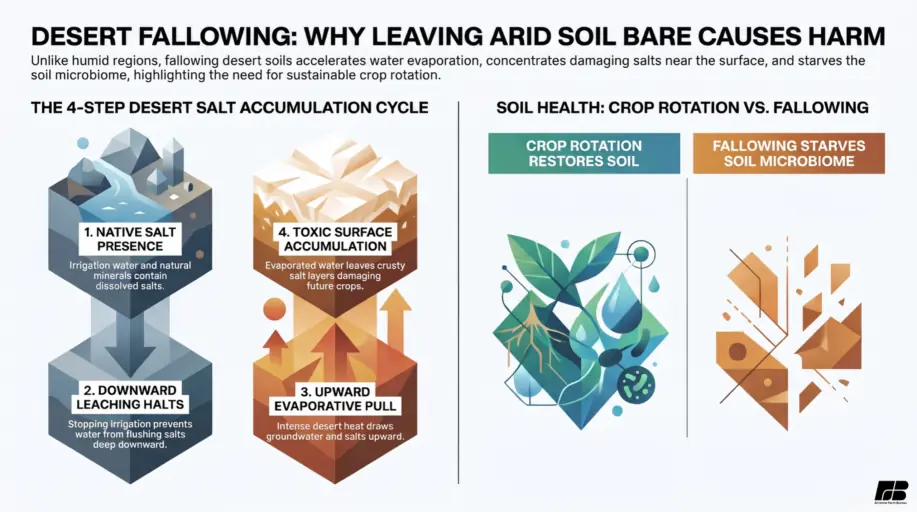
1. Salts are already in the desert soil
Irrigation water (including Colorado River water via the Central Arizona Project) and natural soil minerals contain dissolved salts. Even high-quality irrigation water carries some salts. Under normal farming, these are managed by applying enough water to push (leach) excess salts below the root zone.
2. Fallowing stops the downward flush
When a field is left bare and unplanted, farmers stop irrigating it (often to conserve scarce water). Without regular irrigation or heavy rainfall, there is no water moving downward through the soil to carry salts deeper. In the desert Southwest, annual rainfall is typically far too low to do this job on its own.
3. Evaporation pulls water and salts upward
In arid climates, evaporation rates are very high—far exceeding rainfall. With no crop canopy or plant cover shading the soil or using water, the bare surface dries rapidly. Water from deeper in the soil profile (or from a higher water table) moves upward by capillary action toward the drying surface. As that water evaporates into the air, the salts it carried are left behind, concentrating near the top of the soil.
Dr. Silvertooth noted this is “a particular problem in areas with drainage problems and higher water tables,” because more water is available to move upward and evaporate.
4. The result over time
Salts accumulate in the surface soil, sometimes forming a visible crust. This increases soil salinity in the zone where future crops will try to grow their roots. High salt levels can reduce water uptake by plants, damage seedlings, and lower yields until the salts are flushed out again.
Why This Differs from Wetter Climates
In regions with regular, abundant rainfall, natural leaching often prevents serious salt buildup even on fallowed land. In the hot, dry desert, the balance is reversed: evaporation dominates, and fallowing amplifies salt concentration at the surface instead of resting or improving the soil.
When the land is later returned to production, growers typically must apply extra water specifically to leach the accumulated surface salts downward before crops can thrive again. This is one reason desert agriculture treats fallowing as a water-shortage response rather than a soil-health practice.
For consumers who care about the food grown in Arizona and the long-term health of these productive desert landscapes, the distinction matters. Protecting these soils means recognizing that arid conditions change the rules. Maintaining living plant cover through thoughtful crop rotations—and ensuring adequate water to support both crops and the soil life beneath them—helps sustain the land that supplies much of the region’s agriculture.
By Julie Murphree, Arizona Farm Bureau Director of Strategic Communications


Featured Recipes


COTTAGE CHEESE & BLUEBERRY BREAKFAST BAKE
Read More


Warm Your Soul Lasagna Soup
Read More

Pear Lime Jello Salad
Read More