Blog
Are Nutrition Bars Healthy? What to Look for Before You Grab One

There have been plenty of days when I’ve finished a workout, looked at my schedule, and realized I didn’t have time to sit down for a full meal. That’s usually when a nutrition bar starts looking convenient. It’s quick, easy to throw in my gym bag, and the package might advertise 20 grams of protein, whole grains, or some other nutritional benefit.
Sounds healthy enough, right? That’s what I used to assume. But once I started paying closer attention to nutrition labels, I realized that two bars sitting next to each other can be completely different. One might provide a solid amount of protein and fiber, while another could contain more added sugar and less protein than I’d expect from something marketed as a “nutrition” bar. That doesn’t mean nutrition bars are bad. In fact, they can be incredibly useful when I’m traveling, between meals, heading to the gym, or simply don’t have time to prepare something. The key is knowing what you’re buying.
So, are nutrition bars healthy?
The answer isn’t a simple yes or no. It depends on what’s inside the bar, why you’re eating it, how much you eat, and how it fits into the rest of your diet.
Let’s break it down.
What Is a Nutrition Bar?
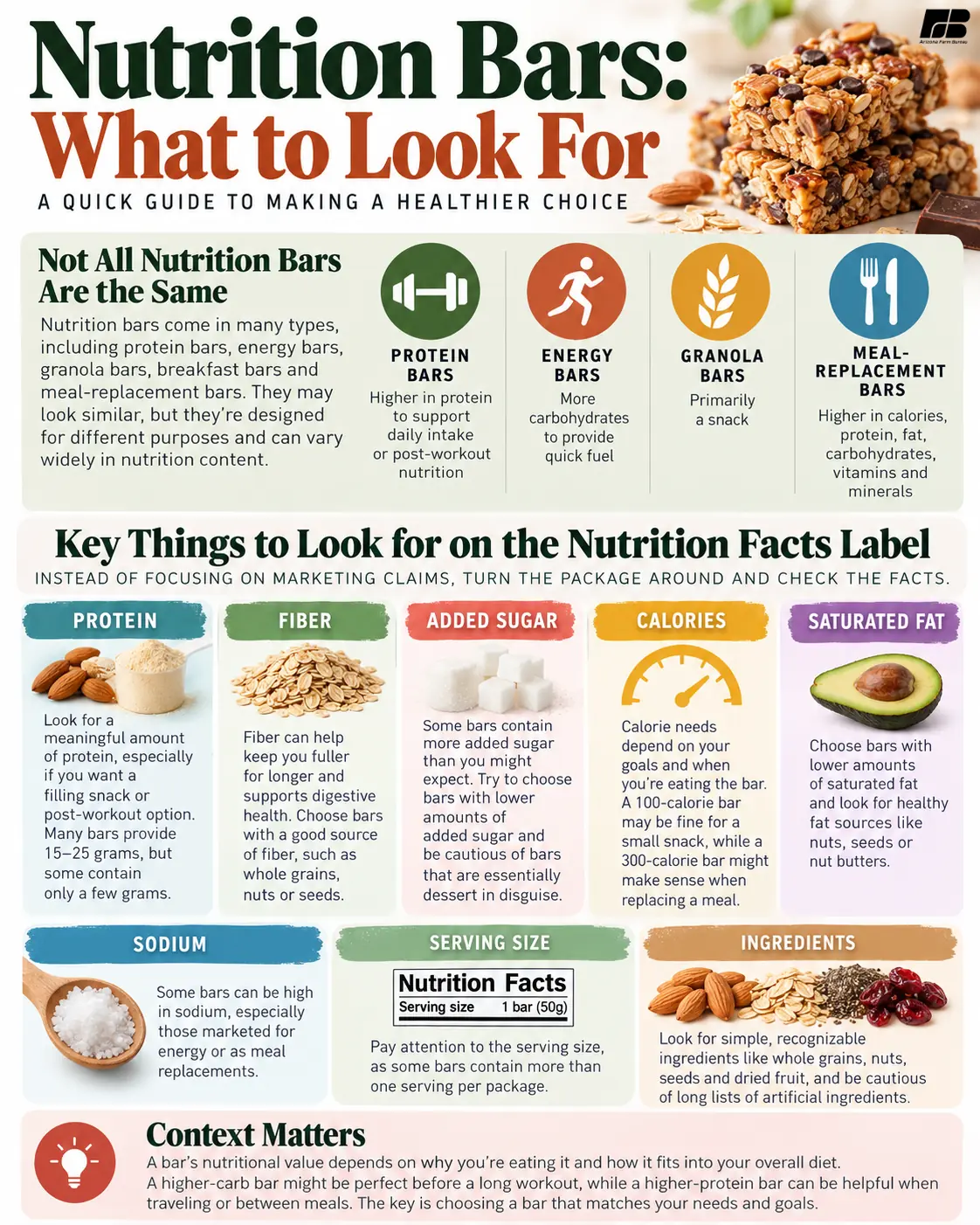
“Nutrition bar” is a broad term. Walk through almost any grocery store and you’ll find shelves filled with protein bars, energy bars, granola bars, breakfast bars, meal-replacement bars, and snack bars. They might look similar, but they aren’t necessarily designed for the same purpose. A protein bar may emphasize protein to support daily protein intake or post-workout nutrition. An energy bar may contain more carbohydrates because it’s intended to provide readily available fuel. A granola bar may function primarily as a snack.
A meal-replacement bar might contain considerably more calories, protein, fat, carbohydrates, vitamins, and minerals because it’s intended to replace a larger eating occasion.
That’s why I don’t think asking whether “nutrition bars” are healthy tells us enough.
A better question is:
What do I need this bar to do?
Once I know that, the Nutrition Facts label becomes much more useful.
Are Nutrition Bars Actually Healthy?
Some can be nutritious choices.
Others are closer to desserts with health-oriented packaging. Most fall somewhere in between. Instead of judging a bar by words like “natural,” “high protein,” “energy,” or “whole grain” on the front, I prefer to turn the package around and look at what it provides.
The U.S. Food and Drug Administration explains that the Nutrition Facts label can help consumers compare foods by looking at serving size, calories, nutrients, and percent Daily Value.
FDA: How to Understand and Use the Nutrition Facts Label
For nutrition bars, I usually pay particular attention to:
- Protein
- Fiber
- Added sugar
- Calories
- Saturated fat
- Sodium
- Serving size
- Ingredients
But I don’t use a single number to decide whether a bar is “good” or “bad.” Context matters. A high-carbohydrate bar might make perfect sense before a long workout but be unnecessary if I’m simply looking for a small afternoon snack.
Likewise, a 300-calorie protein bar might work well when I’m traveling and can’t get a meal. It could be more food than I need if dinner is 30 minutes away.
The bar’s nutritional value needs to match its purpose.
Protein: How Much Should You Look For?
Protein is one of the first things I check, especially if I’m choosing a bar because I want something filling or eating it around a workout. Some bars contain only a few grams of protein. Others provide 15, 20, or even 25 grams. Those aren’t nutritionally equivalent. Protein supplies amino acids that the body uses for numerous functions, including building and repairing body tissues. For people who resistance train, adequate daily protein also plays an important role in supporting adaptations to exercise.
A systematic review and meta-analysis published in the British Journal of Sports Medicine found that protein supplementation can enhance gains in muscle strength and fat-free mass during prolonged resistance exercise training, although the benefits depend partly on overall protein intake.
That doesn’t mean everyone needs a protein bar after every workout. You can get protein from chicken, fish, eggs, dairy, beans, lentils, tofu, and plenty of other foods.
A bar is simply another option. For me, that’s the real advantage. If I know I won’t be able to eat a normal meal for a while, a protein bar makes it easier to hit my daily protein target.
More Protein Isn’t Automatically Better
Here’s where marketing can get tricky. If one bar has 20 grams of protein and another has 30 grams, that doesn’t automatically make the 30-gram bar healthier. You still need to consider the rest of the product. How many calories does it contain? How much added sugar? Does it contain fiber? What’s the serving size? Do you need that much protein at that moment? Protein is important, but nutrition doesn’t suddenly become a competition to find the package with the biggest number on the front. Your total diet matters much more.
Added Sugar: Turn the Package Around
Added sugar is another number worth checking. This is where reading the Nutrition Facts label becomes especially helpful because total sugars and added sugars aren’t the same thing. Total sugars include naturally occurring sugars and added sugars. Added sugars are sugars introduced during processing or preparation. The FDA recommends limiting calories from added sugars to less than 10 percent of total daily calories based on the Dietary Guidelines for Americans. FDA: Added Sugars on the Nutrition Facts Label. So, when I’m comparing two bars, I don’t just look at total carbohydrates. I look specifically at the Added Sugars line.
This doesn’t mean a bar containing added sugar is automatically unhealthy. Again, purpose matters. If you’re doing prolonged endurance exercise, readily available carbohydrates can be useful. If you’re sitting at your desk and choosing a snack, you might prioritize something with more protein and fiber and less added sugar. The problem isn’t that sugar exists. The problem is assuming every bar with healthy-looking packaging has a similar nutritional profile.
Fiber: The Nutrient I Don’t Want to Overlook
Fiber doesn’t get the same attention as protein, but it’s one of the things I like to see in a nutrition bar. Dietary fiber can support digestive health and may make meals and snacks more satisfying. According to the Harvard T.H. Chan School of Public Health, fiber is associated with several aspects of health, including digestive and cardiovascular health.
Bars can get fiber from ingredients such as oats, nuts, seeds, dried fruit, chicory root fiber, or other added fibers. Again, there’s no magic number that makes every bar healthy. But if I’m choosing between two similarly sized snack bars and one contains meaningful amounts of both protein and fiber while the other contains very little of either, that’s useful information. There’s another consideration too. Some bars contain large amounts of added fibers or sugar alcohols. Certain people can experience gas, bloating, or other gastrointestinal discomfort when consuming substantial amounts of these ingredients. That’s especially worth remembering before a workout. The bar that looks perfect on paper isn’t very useful if your stomach hates it.
Calories Matter, but Context Matters More
A common mistake is assuming a lower-calorie bar is automatically healthier. That’s not necessarily true. Suppose I’m looking for a light snack before dinner. A 150-calorie bar might be plenty. But suppose I’ve just finished a hard workout and won’t have access to a meal for several hours. A more substantial bar containing carbohydrates and protein might be much more useful. The opposite can happen too. Some bars are physically tiny but contain 250 to 400 calories because they’re made with calorie-dense ingredients such as nuts, nut butter, chocolate, oils, or dried fruit. Those ingredients aren’t automatically unhealthy. But it’s easy to eat a small bar without realizing how much energy it contains.
That’s why I try to match the calories to the situation rather than thinking:
Lower calories = healthier. Nutrition is rarely that simple.
What’s Actually in the Ingredient List?
I also like looking at the ingredient list, but I don’t use it as a scare tactic.
You’ve probably seen advice saying: “If you can’t pronounce an ingredient, don’t eat it.”
I don’t find that particularly useful. Plenty of perfectly safe food ingredients have unfamiliar scientific names. Likewise, an ingredient being familiar or “natural” doesn’t automatically tell us whether a food is nutritious. Instead, I use the ingredient list to understand what I’m buying.
Depending on the bar, you might see ingredients such as: Oats, dates, peanuts, almonds, whey protein, soy protein, pea protein, chocolate, honey, syrups, dried fruit, seeds, oils, soluble fibers, or sugar alcohols.
None of those ingredients alone tells the whole story. That’s why I prefer using the ingredient list together with the Nutrition Facts panel. One gives me context about what’s in the food. The other tells me how much energy and nutrients I’m getting.
Protein Bars vs. Granola Bars vs. Energy Bars
These categories often overlap, but understanding their general purposes can make choosing easier.
Protein Bars
Protein bars typically emphasize protein and may contain whey, milk, soy, pea, or other protein sources. I tend to use these when increasing protein is one of my main goals. They’re especially convenient when I can’t immediately get a protein-rich meal after training.
Granola Bars
Granola bars commonly contain oats, grains, nuts, seeds, sweeteners, or dried fruit. Some are nutrient-dense. Others contain relatively little protein or fiber and more added sugar. That’s why “granola” doesn’t automatically mean healthy.
Energy Bars
Energy bars often emphasize carbohydrates. That can be useful for people who need fuel for exercise. The word “energy” is worth understanding here. In nutrition, calories are energy. An energy bar doesn’t contain some mysterious ingredient that gives you unlimited stamina. It simply provides calories, often with a significant portion coming from carbohydrates.
Meal-Replacement Bars
These are usually larger and more calorie-dense because they’re designed to replace a meal. Personally, I prefer actual meals whenever they’re practical because they can offer more variety, volume, and enjoyment. But during travel or an unusually busy day, a well-designed meal-replacement bar can be useful. Again, convenience has value.

Are Nutrition Bars Good Before a Workout?
They can be. What I look for before training depends on how much time I have.
Carbohydrates are an important fuel source during moderate-to-high-intensity exercise. Sports nutrition guidance from the Academy of Nutrition and Dietetics, Dietitians of Canada, and American College of Sports Medicine discusses the importance of carbohydrate availability for athletic performance. If I’m eating close to a workout, I generally want something easy to digest.
A bar that’s extremely high in fat, fiber, or sugar alcohols may sit heavily for some people. For longer or more demanding exercise, a carbohydrate-focused bar might make sense. For a short gym session after I’ve already eaten balanced meals throughout the day, I may not need a bar. Listen to your body and consider what the workout requires.
What About After a Workout?
After training, I generally think about two things:
Protein and Carbohydrates
Protein provides amino acids that support muscle protein synthesis and recovery, while carbohydrates can help replenish muscle glycogen used during exercise. A nutrition bar containing both can therefore be convenient after training. But there’s an important distinction. Convenient doesn’t mean necessary. If I can get home and eat chicken, rice, vegetables, and fruit, I don’t need a protein bar just because I finished a workout. The bar becomes valuable when the alternative is going several hours without eating or grabbing something that doesn’t fit my goals as well. That’s where nutrition bars shine. They’re convenient tools. They’re not nutritional requirements.
Can Nutrition Bars Help With Weight Loss?
They can fit into a weight-loss plan, but eating nutrition bars doesn’t inherently cause weight loss. Fat loss requires an appropriate calorie deficit over time. A nutrition bar may help because it’s portioned, portable, and easy to track. Protein and fiber can also contribute to satiety, depending on the bar and the rest of your diet. But there’s another side. Some bars contain several hundred calories and are easy to eat quickly. If you’re adding them on top of your normal meals rather than using them strategically, those calories still count. That’s why I wouldn’t buy a bar simply because the package says things like:
“Fit.”
“Lean.”
“Protein.”
“Natural.”
“Energy.”
Those words don’t determine whether the product fits your calorie needs. The Nutrition Facts label gives you much more useful information.
Nutrition Bars vs. Whole Foods
This is where balance matters. I like nutrition bars. I also don’t want them replacing most of my meals. Whole foods such as fruits, vegetables, whole grains, legumes, nuts, dairy, eggs, fish, and lean meats can provide combinations of vitamins, minerals, fiber, protein, healthy fats, and other beneficial compounds. They also give you more variety. For example, compare grabbing a protein bar with sitting down to Greek yogurt topped with berries, oats, and nuts. The bar wins on portability. The yogurt bowl may provide more volume, variety, and the opportunity to include fruit and other whole-food ingredients. Neither option must be universally “better.” The best choice depends on where I am, how much time I have, what I’ve already eaten, and what I need next. That’s why I think of bars as supplements to a balanced diet, not its foundation.
How I Choose a Nutrition Bar
When I’m standing in the store trying to decide between ten different bars, I don’t spend 20 minutes analyzing every ingredient.
I ask a few simple questions:
- Why am I eating this? Is it a snack, pre-workout fuel, post-workout protein, or temporary meal replacement?
- How much protein does it provide? If I’m buying a protein bar, I expect protein to be a strength.
- Does it contain fiber? Fiber can make the bar more satisfying, although I don’t necessarily want huge amounts right before training.
- How much added sugar is there? I compare it with similar products rather than automatically rejecting any bar containing sugar.
- How many calories am I getting? I make sure the calories match what I need the bar to accomplish.
- How does my stomach handle it? This matters more than people think. A bar that consistently causes bloating isn’t going back in my gym bag.
That’s basically it. I don’t need the perfect bar. I need one that works for what I’m trying to accomplish.
Knowing how to read a nutrition label is one thing. Knowing how much protein, carbohydrates, fat, fiber, and total energy you need is another. That’s where a personalized approach can make nutrition much simpler. Instead of labeling foods as good or bad, I prefer looking at how foods fit into your training, lifestyle, preferences, and goals. Nutrition bars can be part of that plan, but they shouldn’t have to replace a balanced diet. The goal isn’t to eat perfectly. It’s to build an approach you can stick with.
By Joel Carr, Arizona Farm Bureau Strategic Communications Manager



Featured Recipes


COTTAGE CHEESE & BLUEBERRY BREAKFAST BAKE
Read More


Warm Your Soul Lasagna Soup
Read More

Pear Lime Jello Salad
Read More