
Blog
How Much Cotton Does Arizona Produce? Well, It Depends

We love answering questions about Arizona cotton and why we grow this amazing fiber in our desert environment. The most recent question, “How much cotton does Arizona produce?”
Here’s current figures, according to the United States Department of Agriculture (USDA).
According to the USDA, for the 2025 crop year (last year), data shows Arizona planted 102,500 acres of all cotton.
- Upland cotton: 87,000 acres planted (86,000 harvested).
- Pima cotton: 15,500 acres planted (15,500 harvested).
This is reflected in the 2025 State Agriculture Overview (data as of early 2026) and aligns with final production figures around 280,000 bales.
For the 2026 crop year (current), USDA Prospective Plantings (released March 31, 2026) and the 2026 State Agriculture Overview indicate intended planted acres of 95,000 for all cotton, according to the USDA’s data gurus.
- Upland cotton: 80,000 acres.
- Pima (ELS) cotton: 15,000 acres.
This represents a slight decline from 2025 intentions/plantings. Nationally, 2026 all-cotton planted acres are estimated at 9.64 million (up 4% from 2025).
These are the latest available USDA/NASS figures. The 2026 numbers are intended plantings from the March Prospective Plantings report; actual planted acres may be updated in the June Acreage report.
Acreage has fluctuated over the decades. Peak production reached nearly 700,000 acres statewide in the 1950s; in recent years planted acres settle between 90,000 and 130,000. Yet the value endures. A 2025 University of Arizona Cooperative Extension study found that cotton farming and ginning together generated $322 million in total economic output in 2022, supported 1,446 jobs and added $132 million to gross state product.
Arizona’s cotton planting often starts early, with progress reports noting it leading the nation in early-season planting.
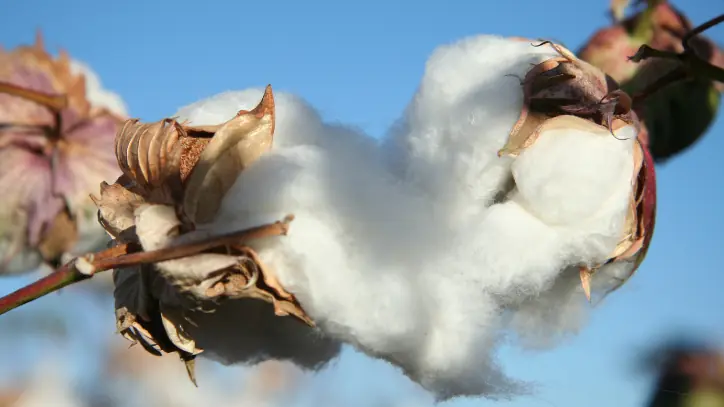
The Amazing Story of Arizona Cotton
Arizona cotton, irrigated under the desert sun rather than battered by rain, ranks among the whitest and highest-quality fiber produced anywhere in the world, powering a resilient industry that contributes more than $320 million annually to the state’s economy while slashing its environmental footprint.
Farmers here have grown cotton commercially since 1917, building on a tradition that dates to the Hohokam people who cultivated it along the Gila and Salt rivers more than 1,000 years ago. Today, Arizona leads in extra-long-staple Pima cotton — prized for its strength, softness and silkiness — and consistently posts yields twice the national average.
The story of Arizona cotton defies the common question once posed by an out-of-state reporter: “Why in God’s name are we growing cotton in the desert?” The answer, say growers and experts, lies in the state’s climate, precision irrigation and relentless innovation. “Arizona cotton, along with California cotton, is some of the whitest, highest-quality cotton around,” Previous cotton farmer with her parents and Arizona Farm Bureau Director of Strategic Communications Julie Murphree has noted in multiple reports. “One main reason is that Arizona and California irrigate the cotton. With so little rainfall in the southwest, the cotton fiber is not at risk for compromised quality due to wind and rain.”
That quality edge traces directly to the state’s arid conditions and managed water use. Unlike the 60 percent of U.S. cotton grown under rainfall elsewhere, Arizona fields avoid the fiber degradation that comes with storms. The result: premium bales suited for everything from luxury bedsheets and medical gauze to durable currency and iconic blue jeans.
Pima cotton’s Arizona roots run deep. The U.S. Department of Agriculture’s breeding program in Sacaton developed the extra-long-staple variety that became known as Pima — named in honor of the Pima Indians who helped raise the early crops on the experimental farm. Dr. Carl V. Feaster, a legendary geneticist whose work was based in Arizona, earned recognition worldwide as the father of modern Pima cottons.

Despite water challenges and dramatic water cuts from the Colorado River, Pinal County ranks in the top 1 percent of U.S. counties for cotton and cottonseed sales. Arizona stands among the nation’s top three Pima producers, California being another one of the states. Arizona Farm Bureau President John Boelts, a Yuma farmer who grows cotton and produce, put it plainly: “Arizona’s cotton farmers boost our economy by over $320 million annually, producing top-quality cotton fibers for essentials like bed sheets, medical gauze, durable paper currency, and denim jeans.”
Sustainability gains have been dramatic. Arizona cotton growers cut pesticide applications from nine per acre in the mid-1990s to just 0.58 per acre by 2023 — the lowest rate among cotton-producing states and less than one-fifth the national average. Water efficiency improved markedly: growers now produce 32 percent more lint per acre-foot of water than they did 40 years ago.
“Arizona cotton used to be a high-pesticide use crop; now it is a low-pesticide use crop,” said George Frisvold, University of Arizona professor and extension specialist. “Arizona’s drop compared to the rest of the Cotton Belt is a testament to the state’s Integrated Pest Management programs. The improvement in water use efficiency is also impressive. Arizona cotton growers are getting a lot more ‘crop per drop’ than they did 40 years ago.”
The industry participates in the U.S. Cotton Trust Protocol, which tracks six key sustainability metrics and enrolled 18,500 Arizona acres in 2025. Nationwide, U.S. cotton has reduced soil loss by 68 percent, water use by 75 percent in irrigated fields and pesticide applications by 50 percent over 25 years. Cotton plants worldwide remove enough carbon dioxide equal to taking 7 million cars off the road.
Cotton itself tells a story of renewal. The natural cellulose fiber biodegrades completely — even 100 percent cotton items can break down in weeks — unlike synthetic microfibers. It is also a dual-purpose crop: the fiber for textiles, the seed for healthy cooking oil and livestock feed.

Farm families carry the legacy. Fourth-generation grower and Arizona Cotton Growers President Cassy England of Sierra Farming in Pinal County partners with her uncle on cotton, wheat and alfalfa. She and other multi-generational operations embody the pride Arizona farmers feel each harvest.
Rick Lavis, former executive vice president of the Arizona Cotton Growers Association, captured the ethos in 2016: “We’ve been farming cotton commercially in Arizona since 1917 … we can create this kind of high-quality product out here because we manage our resources so well. And as a result, our cotton yields are consistently twice the national average.”
From the ancient Hohokam canals to today’s precision drip systems and biotech seed varieties, Arizona cotton proves that the desert is not a limitation but an advantage — producing “fancy fabric,” as the Arabic root of the word suggests, with unmatched quality and growing environmental stewardship.
As one Arizona Farm Bureau report summed it up, the state’s cotton is renewable, biodegradable and economically vital. In a world seeking sustainable choices, Arizona farmers continue to deliver fiber that is not only world-class but also a model for responsible production.


Featured Recipes


COTTAGE CHEESE & BLUEBERRY BREAKFAST BAKE
Read More


Warm Your Soul Lasagna Soup
Read More

Pear Lime Jello Salad
Read More