
Blog
The New Food Pyramid: A Historic Reset in U.S. Nutrition Guidance
In January 2026, the U.S. Departments of Agriculture (USDA) and Health and Human Services (HHS) unveiled the Dietary Guidelines for Americans, 2025–2030, under the leadership of HHS Secretary Robert F. Kennedy Jr. and USDA Secretary Brooke Rollins. At the heart of this release is the New Food Pyramid—a bold return to a familiar icon, now reimagined to put “real food” front and center.
After more than a decade dominated by the simpler MyPlate graphic, the pyramid is back, flipped in emphasis to combat what officials call a national health crisis driven by ultra-processed foods. From pyramid to plate and back to a pyramid, the effort is to make the new pyramid simple to view and understand.
“These Guidelines return us to the basics,” Kennedy said in the January 7th press release. “American households must prioritize whole, nutrient-dense foods—protein, dairy, vegetables, fruits, healthy fats, and whole grains—and dramatically reduce highly processed foods. This is how we Make America Healthy Again.” The move marks the most significant overhaul of federal nutrition policy in decades, reclaiming the pyramid as an educational tool while grounding recommendations in what proponents call modern nutrition science.
For readers of Fill Your Plate, this isn’t just another government update, it’s a practical roadmap for families seeking clearer, more intuitive guidance on what to put on the table. Let’s break down the new pyramid, contrast it with its predecessors, and dive into the rigorous scientific process behind it.
What the New Food Pyramid Looks Like—and Why It Matters
Recently, on the “Fill Your Plate Now” Podcast, nutritionist Tammy Baker and co-host broke down the details of the newly released pyramid and what listeners could learn from this change. Baker also emphasized that some aspects of the new pyramid should be simple for families to apply to their daily diet.
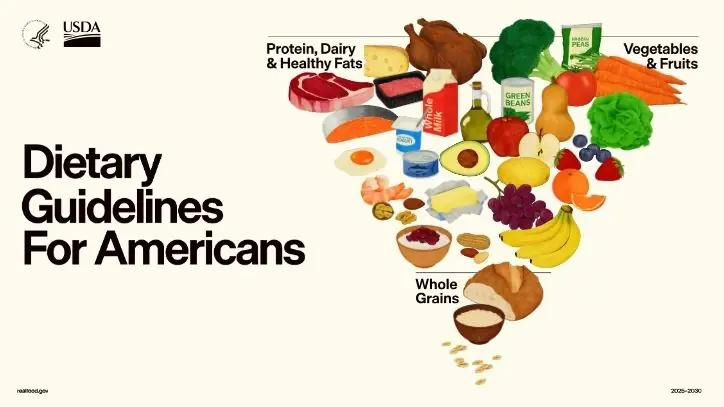
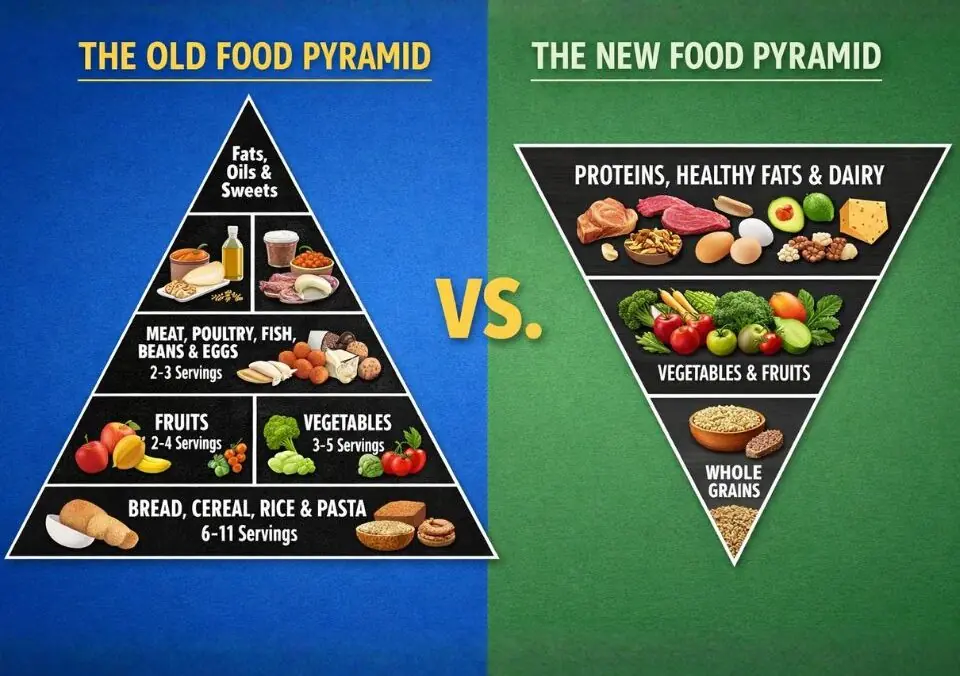
The New Food Pyramid is described as an inverted version of the classic 1992 model. Where the old pyramid placed carbohydrate-heavy grains at the wide base (signaling they should make up the bulk of the diet), the new graphic positions protein-rich foods and vegetables at the broad base, only this time on the top of an inverted pyramid. Whole grains are relegated to the smallest section at the very bottom. Vegetables and fruits form another large, prominent layer, while dairy (now including full-fat options) and healthy fats share space with proteins at the top of the new inverted pyramid.
Official servings for a 2,000-calorie diet (adjustable by age, sex, activity, and needs) include:
- Protein: 1.2–1.6 grams per kilogram of body weight daily (roughly 50–100% higher than the previous 0.8 g/kg minimum). Think eggs, seafood, a variety of protein meats, beans, nuts, and seeds at every meal.
- Vegetables: Three servings daily, prioritizing whole, colorful, minimally processed forms.
- Fruits: Two servings daily, focusing on whole fruits.
- Whole grains: Two to four servings daily (oats, rice, sourdough), with refined carbs sharply limited.
The overarching message: Eat real food. The guidelines define this as whole or minimally processed items with few ingredients—no added sugars, artificial flavors, preservatives, or dyes. For the first time, federal advice explicitly urges Americans to avoid highly processed foods (think packaged snacks, sodas, ready-to-eat meals) that now make up nearly 70% of children’s diets. Hydration comes from water or unsweetened beverages, and alcohol should be limited.
This visual and messaging shift is designed to be intuitive. Instead of debating plate fractions, families see at a glance that protein, veggies, and healthy fats form the foundation—crowding out the ultra-processed items blamed for driving chronic disease rates to record highs (50% of adults with prediabetes or diabetes; 75% with at least one chronic condition).
Old Food Pyramid vs. New Food Pyramid vs. MyPlate: A Clear Contrast
To appreciate the transformation, compare the icons across eras.
The 1992 Food Guide Pyramid (used through 2005, with a 2005 MyPyramid tweak) placed grains at the base—six to 11 servings daily—with vegetables and fruits in the next tier, dairy and meat limited to two to three servings each, and fats/sweets at the tiny tip. Critics later argued it unintentionally promoted refined carbs and failed to distinguish whole from processed foods, coinciding with rising obesity and metabolic disease.
In 2011, USDA retired the pyramid for MyPlate: a simple dinner-plate graphic showing half the plate as fruits and vegetables, one-quarter grains, one-quarter protein, and a side cup of dairy. The emphasis shifted toward balance and portion awareness, with low-fat or fat-free dairy strongly preferred and added sugars capped at 10% of calories. MyPlate was praised for simplicity but criticized for downplaying protein needs and not addressing ultra-processed foods head-on.
The 2025–2030 New Food Pyramid inverts priorities dramatically. Protein and vegetables now anchor the inverted pyramid. Full-fat dairy is welcomed rather than restricted. Whole grains shrink in visual prominence despite the 2–4 serving recommendation. Most notably, the guidelines introduce an explicit anti-processed-food stance absent from prior versions.
Key quantitative contrasts to the Updated Food Pyramid:
- Protein: Previously a modest 0.8 g/kg; now 1.2–1.6 g/kg, with every meal built around it.
- Dairy fat: Low-fat or fat-free recommended for decades; now full-fat options are highlighted.
- Added sugars: Still limited, but stricter messaging (no added sugars for children under 10; aim for under 10 g per meal).
- Processed foods: Newly called out for avoidance.
Rollins emphasized the farmer-first angle: “We are realigning our food system to support American farmers, ranchers, and companies that grow and produce real food.”
The Science Behind the Shift: Rigorous Review Meets Policy Reset
How did USDA and HHS arrive at these changes? The process follows a decades-old framework but with notable updates under the current administration.
Every five years, the Dietary Guidelines draw from the Dietary Guidelines Advisory Committee (DGAC)—an independent panel of 20 nationally recognized scientists. Appointed in 2023, the 2025 DGAC (chaired by experts including Dr. Sarah Booth of Tufts University and including researchers from institutions like UC San Diego, Rutgers, and the USDA Human Nutrition Research Center on Aging) spent two years conducting systematic evidence reviews. They examined hundreds of peer-reviewed studies on dietary patterns, life-stage needs, chronic disease risk, and health equity. Meetings were livestreamed, public comments solicited, and members underwent ethics training and conflict-of-interest vetting. Their 400-plus-page Scientific Report, submitted in December 2024, synthesized the strongest available evidence on topics like protein requirements for muscle health and satiety, the metabolic impacts of ultra-processed foods (linked in large cohort studies to obesity, diabetes, depression, and certain cancers), and dairy fat’s evolving reputation.
The final guidelines, however, incorporated a supplemental scientific analysis commissioned through a federal contracting process after the administration reviewed the DGAC report. This supplemental work underwent internal quality checks and external peer review, focusing on “scientific rigor” to support the “eat real food” framework. Officials cite mounting data showing ultra-processed foods displace nutrient-dense options and contribute to trillions in healthcare costs. Higher protein targets draw from evidence on satiety, metabolic function, aging muscle preservation, and stable energy. Full-fat dairy’s inclusion aligns with recent meta-analyses showing neutral or protective effects on cardiovascular risk when part of whole-food patterns, contrasting the earlier low-fat dogma. The 10% saturated-fat cap remains, but the pyramid’s visual grouping of animal proteins and full-fat dairy with healthy fats aims to encourage nutrient-dense choices over processed alternatives.
The Academy of Nutrition and Dietetics echoed implementation worries but acknowledged progress on added sugars and processed foods. Proponents counter that the final product restores “common sense” and scientific integrity, prioritizing food over pharmaceuticals amid a crisis where diet-related chronic disease consumes 90% of U.S. healthcare spending.
Practical Takeaways for Families and Fill Your Plate Readers
The new pyramid isn’t a rigid diet—it’s a flexible framework customizable to cultural traditions, budgets, and preferences.
Start simple: build every plate around protein and vegetables. Swap soda for water. Choose full-fat plain yogurt over sweetened versions. Shop the perimeter of the store for whole foods.
Federal programs (school lunches, WIC, SNAP) will gradually align, potentially increasing whole-food options and scratch cooking. Nutrition educators anticipate needing updated materials, but the pyramid’s visual clarity should help.
As Arizona nutrition experts noted, Americans have long struggled to meet guidelines; success will require better access, education, and policy support. Yet the message is empowering: better health begins on your plate.

The 2025–2030 Dietary Guidelines and New Food Pyramid represent a paradigm shift—reclaiming an iconic tool, elevating real food, and confronting ultra-processed products head-on. Whether you’re a busy parent packing lunches or a grandparent managing blood sugar, the science-backed emphasis on nutrient density offers a clearer path forward.
Download the full guidelines at realfood.gov and experiment with the pyramid this week. Your plate and your health will thank you!
The new pyramid isn’t a rigid diet—it’s a flexible framework customizable to cultural traditions, budgets, and preferences.
Start simple: build every plate around protein and vegetables. Swap soda for water. Choose full-fat plain yogurt over sweetened versions. Shop the perimeter of the store for whole foods.
Federal programs (school lunches, WIC, SNAP) will gradually align, potentially increasing whole-food options and scratch cooking. Nutrition educators anticipate needing updated materials, but the pyramid’s visual clarity should help.
As Arizona nutrition experts noted, Americans have long struggled to meet guidelines; success will require better access, education, and policy support. Yet the message is empowering: better health begins on your plate.
The 2025–2030 Dietary Guidelines and New Food Pyramid represent a paradigm shift—reclaiming an iconic tool, elevating real food, and confronting ultra-processed products head-on. Whether you’re a busy parent packing lunches or a grandparent managing blood sugar, the science-backed emphasis on nutrient density offers a clearer path forward.
Download the full guidelines at realfood.gov and experiment with the pyramid this week. Your plate and your health will thank you!



Featured Recipes


COTTAGE CHEESE & BLUEBERRY BREAKFAST BAKE
Read More


Warm Your Soul Lasagna Soup
Read More
Pear Lime Jello Salad
Read More