
Blog
The Water in Your Salad Bowl: Why New Farm Water Matters to Every Arizona Table
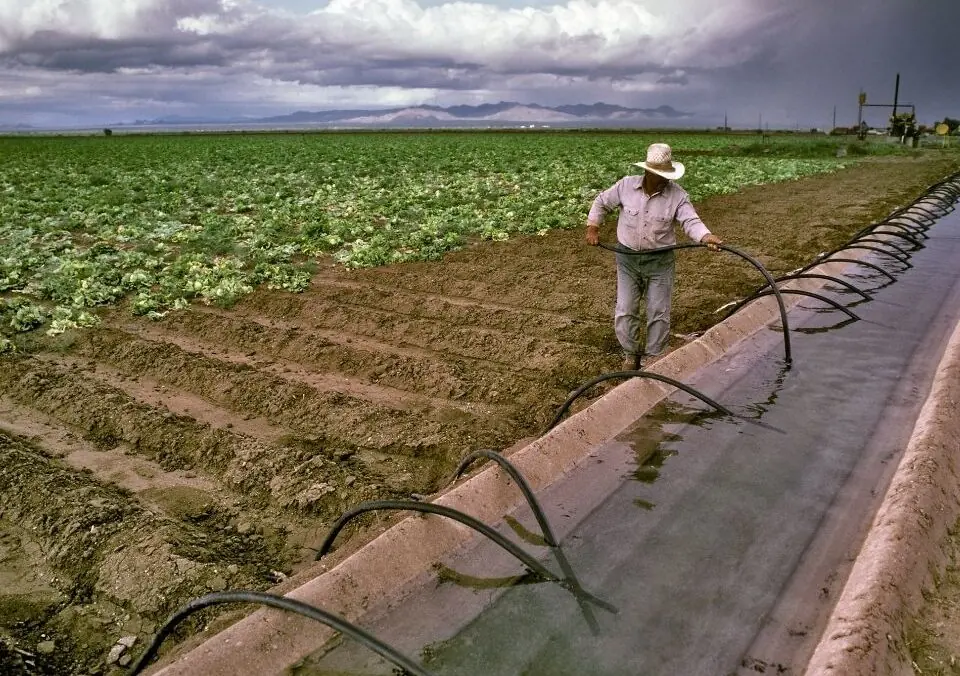
By the time a head of Yuma lettuce, a glass of Arizona milk, or a handful of local pecans reaches your kitchen, a lot of water has already done its job. Unless you’re a farmer irrigating his crops, you never see that water. You just see dinner.
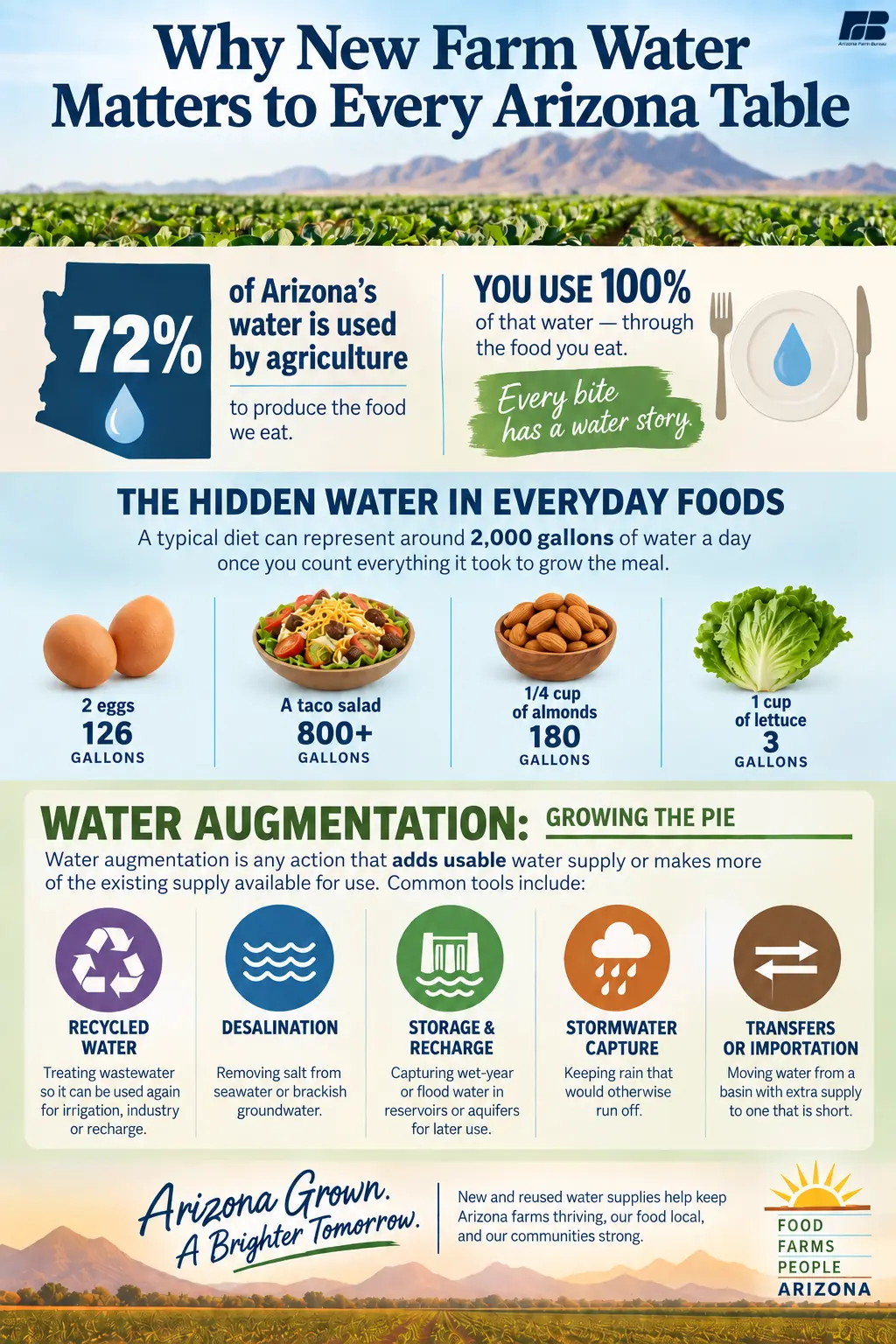
In Arizona, agriculture uses around 72% of the water Arizona possesses underground and from our surface water sources to produce food. But you and I use 100% of that water either through the food we eat.
That’s why a fairly technical debate — recycled water, desalination plants, canals that move water from one region to another — belongs on our Fill Your Plate site. This is not a fight that stays on the farm.
Well, not a fight but a forum for understanding.
When a state’s water gets scarce or too expensive for growers, the effects show up in what is on the shelf, what it costs, and whether it was grown here or shipped from somewhere with different rules.
Arizona Farm Bureau built Fill Your Plate so families could reconnect with the people who grow our food. Water is part of that story.
We’re about to discover the term “water augmentation:” Any action adding to the water pool.
The Water World of Augmentation
Water augmentation is any action that adds usable water supply or makes more of the existing supply available for use, instead of only cutting demand.
In water management, that usually means creating, recovering, storing, or importing water so farms, cities, and the environment have more to work with.
Common augmentation tools include:
- Recycled or reclaimed water — treating wastewater so it can be used again for irrigation, industry, or recharge
- Desalination — removing salt from seawater or brackish groundwater
- New storage and groundwater recharge — capturing wet-year or flood water in reservoirs or aquifers for later use (Something Arizona’s done really well.)
- Stormwater capture — keeping rain that would otherwise run off
- Transfers or importation — moving water from a basin with extra supply to one that is short
- On-farm or canal projects that create real extra yield — lining, piping, or drainage reuse, when the saved water is actually available as new supply
It is the opposite of relying only on conservation, fallowing, or “buy and dry” transfers. Conservation uses less water. Augmentation tries to grow the pie.
In agriculture, the term comes up when growers and groups such as Arizona Farm Bureau and the Family Farm Alliance argue that cities and farms cannot keep splitting a shrinking river, think the Colorado River. They want new or reused gallons, so food production is not the default source of water for growth.
Your Grocery Cart is A Water Cart
As stated earlier, Arizona agriculture uses about 72% of the state’s water, according to the Arizona Department of Water Resources. That number startles people until they remember what those farms produce: winter vegetables for much of the country, dairy, beef, cotton, citrus, melons, dates, wheat, and the alfalfa that keeps local milk in local stores.
Arizona Farm Bureau has said this for years in another way: when you waste food, you waste water. A typical diet can represent around 2,000 gallons of water a day once you count everything it took to grow the meal. Two eggs, about 126 gallons. A taco salad, more than 800. A quarter cup of almonds, about 180 gallons.
So, the question is not whether Arizona and American farms use water. Of course they do. The question is whether we will have enough affordable water to keep growing food close to home.
Why “Just Use Less” Is Not the Entire Answer
Farmers are already squeezing more crop from every drop. Drip lines, laser-leveled fields, soil-moisture sensors, and district canal upgrades are normal tools now, not novelties. In Yuma, studies have pointed to more than $1,500 in crop sales per acre-foot of water, an efficiency story most shoppers never hear.
Efficiency helps. It cannot invent a river.
The Colorado River system that fills so many Arizona canals is over-committed. Groundwater in Active Management Areas is capped. Cities are growing. And farm groups such as the Family Farm Alliance, which represents irrigators across 17 Western states, have been blunt: “treating farms as a spare tank for new suburbs is not a long-term plan. If you permanently move low-cost farm water into cities, you lose the flexibility that gets communities through the next drought—and you shrink the land that feeds people.”
That is why growers talk about “growing the pie.” They mean new or reused supplies: recycled water, storage and underground recharge, some desalination, and smart transfers.
Farm Bureaus in irrigated regions have said the same thing in plainer language. Arizona Farm Bureau, for example, supports augmentation efforts including recycling water, and argues that farm irrigation should be high up on the list for that water when it is suitable for crops.
Statewide, Arizona’s own conversation is heading in the same direction: reuse more, store more, and do not assume the desert can keep producing food on leftover gallons.
Recycled Water: The Option That Fits a Farm Budget
If there is a hero in this story for consumers, it is recycled water—treated wastewater cleaned to a standard that matches the crop and meets regulatory requirements.
This is not science fiction. Arizona has used recycled water for landscapes, industry, recharge, and certain farm crops for decades. State figures have put recycled water at roughly 4% of Arizona’s annual use, around 260,000 acre-feet in earlier Department of Water Resources estimates, and it is one of the few supplies that grows as cities grow.
And On-Farm Example: Every dairy in Arizona recycles the water they use, typically four times from original use; some dairies are capable of recycling 5 to 6 times.
California offers a picture of what farm-scale reuse looks like. Monterey County irrigates thousands of acres of salad crops with recycled water after years of food-safety testing. In 2024, Escondido opened a plant built just for farmers. It takes water that used to flow to the ocean, treats it for avocado orchard use, and sells it cheaper than drinking water. The city gets a customer. Growers get a local supply. Households keep potable water for taps.
Cost is why reuse beats many headlines. Cleaning wastewater for irrigation is usually far cheaper than turning ocean water into farm water. A Spanish study comparing the two found recycled irrigation water returned about $17 in benefits for every $1 invested, versus about $4 for desalinated seawater. In the Southwest, researchers have ranked filtered, disinfected municipal wastewater as the most affordable “new” irrigation source, ahead of desalting brackish wells, treating oilfield water, or desalinating the sea.
Is every gallon of recycled water right for every crop? No. Salts, nutrients, and food-safety rules matter. States set different standards for lettuce versus cotton versus orchard fruit. Done right, though, reuse can also replace some fertilizer because leftover nitrogen and phosphorus are plant food.
For a shopper, the takeaway is simple: the wastewater leaving a city can become the irrigation that grows the next food item on your menu, if we build the pipes and the treatment and we trust farmers to use it under clear rules.
Desalination: Drought-Proof, and Usually Too Pricey for the Field
Desalination is the idea people picture first. Take salty ocean water or salty groundwater, push it through membranes, and make fresh water. Israel and Spain already irrigate high-value greenhouses this way. Arizona agencies have even studied coastal desalination in Mexico, paired with water exchanges, as one future tool.
Here is the part that rarely makes the viral post: most farmers cannot pay what desalinated water costs.
In some estimates, desalting brackish groundwater for crops has been estimated around $800 per acre-foot. Ocean water, once you add the energy to clean it and the cost to pump it inland and uphill, can run into the thousands. One study of delivering Pacific desalinated water to high-desert cities in New Mexico put the full cost above $2,000 per acre-foot.
That gap is the whole ballgame. A pistachio or greenhouse tomato grower facing a cut-off well might pay a premium. A farm growing wheat, cotton, or the alfalfa that feeds Arizona dairy cows generally cannot. The United Nations Food and Agriculture Organization has said even the cheaper end of modern seawater desalination is still a stretch for most farmers without subsidies, nearby plants, and high-value crops.
So, when farm organizations support desalination research, they are usually not asking every grower to buy ocean water at city prices. They are asking cities to develop drought-proof supplies so river water can stay on food-producing land. That distinction matters if you like Arizona vegetables in January.
Moving Water from Wet Places to Dry Ones
The West already moves water on a heroic scale. Southern California and Arizona have depended on transfers from the Colorado River for decades. Denver drinks water that started on the other side of the Rockies. Arizona’s Central Arizona Project is itself a transfer: Colorado River water lifted and carried across the desert to farms and cities. The Central Arizona Project is an engineering marvel, making the desert more productive.
Some transfers protect food production. The Imperial Irrigation District’s long-term deals send conserved water to San Diego and other urban users while funding canal lining and on-farm upgrades—so the winter vegetable industry can keep running instead of being bought out. Other transfers are the ones rural communities fear: “buy and dry,” where a city purchases a farm’s water right and the field goes idle for good.
Family Farm Alliance members have participated in temporary, paid transfers in places like Imperial, the Klamath, and the Central Valley. Their preference is the first kind: conservation that keeps land in farms, not a permanent shrinking of the landscape.
Arizona is now exploring a new generation of ideas—modernizing irrigation and trading the savings, treating wastewater on both sides of the border, even pairing Mexican desalination with river exchanges. Those projects are years from a faucet. They show the direction, though: create water where it is abundant or wasted, then share it through rules people can live with.
Arizona irrigation districts are looking at ways to import water from other places, and some deals feel close.
Giant pipelines from faraway wet regions make good drawings and hard politics. Climate change also means the “wet” basin may not stay wet. The transfers most likely to help your plate are the unglamorous ones: wet-year flood water banked underground, city reuse traded for farm river water, and conserved canal water moved under contract.

What Farm Bureau and Other Farm Groups are Actually Asking
Strip away the acronyms and the ask is consistent.
The Family Farm Alliance wants new storage, recharge, recycling, and desalination so growing cities are not built on top of the farm water supply. Its 2026 gathering is literally themed “Growing the Pie.”
Farm Bureau organizations want affordable, reliable water for food production. Locally, that includes support for recycled-water pipelines and brackish treatment. Nationally, Farm Bureau has also fought for clearer clean-water rules so ordinary ditches, reuse plants, and recharge basins are not buried in permit confusion that makes projects slower and costlier.
The California Farm Water Coalition, which works with those same Western groups, puts it in a sentence shoppers can steal: the water farmers use does not stay on the farm. It comes back in the food we buy.
Why You Should Care Even If You Never Set Foot in a Cotton Field
First, price and availability. Arizona’s climate is a food engine because irrigation makes winter production possible. If that water becomes scarce, lettuce, milk, beef, and melon production do not pause politely. Some acres fallow. Some shift to solar. Some production leaves the country. You pay at the register, or you import the meal.
Second, community. Irrigation is not only a farm expense. It underwrites jobs in towns from Yuma to Pinal County—packing sheds, trucking, dairies, implement dealers, and the tax base that keeps rural schools open. Idle land from missing water is not a neutral environmental win. It is a smaller local food system.
Third, honesty about the environment. Taking water off farms does not automatically “give it back to nature.” Return flows from irrigation support habitat and, in some basins, the water that later fills city wells. Recycled water used on fields can keep nutrients out of rivers. Desalination has energy and ocean impacts of its own. Grown-ups compare whole systems.
Hang out with an Arizona rancher for any length of time especially if he can convince you to help with roundup, you’ll see wildlife right next to his cattle at the same drinker or water tank.
Fourth, the bargain is already in the books. Those inexpensive farm deliveries exist because earlier generations built dams, canals, and the Central Arizona Project. New recycled-water plants will exist because this generation pays for pipes and treatment. The public choice is which investment we make next. Using the old system as a discount tank for new lawns and data centers is how a food state talks itself out of being a food state.
You do not need to become a water lawyer. You can do three practical things.
- Do not waste the food that already contains the water.
- Buy Arizona in season when you can. Fill Your Plate exists to make that easier.
- And when water projects show up in the news, listen for a simple test: does this create more usable water, or does it only move the shortage onto the people growing dinner?
Farmers will keep chasing more crop per drop. They must. The rest of us have a part, too. If we want Arizona food on Arizona plates, we have to be willing to talk about the unglamorous work that keeps water in the field: recycling what cities already used, storing wet years for dry ones, and building the expensive new supplies for growing towns so the river water that grows lettuce, milk, and beef can stay in the food system.
That discussion belongs to every household that eats. Which is all of us.
Information compiled by Julie Murphree, Arizona Farm Bureau Director of Strategic Communications


Featured Recipes


COTTAGE CHEESE & BLUEBERRY BREAKFAST BAKE
Read More


Warm Your Soul Lasagna Soup
Read More

Pear Lime Jello Salad
Read More